


Ramadan-Ready Gym & Studio Operations: Scheduling, Payments & Member Communications
Ramadan reshapes daily life across the GCC more than almost any other stretch of the year — and for gyms, studios, and sports academies, it reshapes the entire business. Attendance patterns flip, peak hours move to the middle of the night, and members expect their gym to understand what they’re going through, not just keep the lights on at the usual times. Operators who plan for this in advance keep members engaged through the month; operators who don’t tend to watch attendance quietly collapse until Eid.
This guide covers what actually changes during Ramadan for a GCC fitness or Sports Business, the schedule and class formats that work, how to handle membership freezes and billing without losing revenue or trust, and a practical checklist for getting your software ready — plus what to do for Eid closures and the post-Ramadan attendance recovery that follows every year.
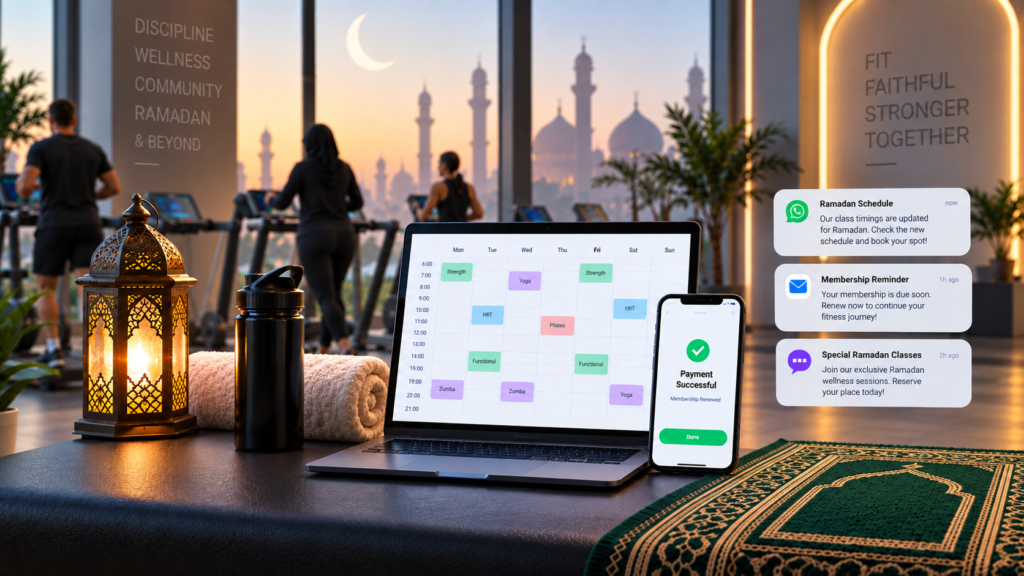
Why Ramadan changes everything for GCC gyms
The most visible shift is attendance timing. Daytime foot traffic drops sharply once fasting begins at Fajr, and it doesn’t fully recover until after Iftar — the sunset meal that breaks the fast. Across the region, the fitness industry effectively runs a split schedule for the entire month: a quiet daytime lull, a near-total closure window around Iftar itself, and then a second, often busier peak that runs from shortly after Iftar until the early hours of the morning. In Saudi Arabia specifically, many gyms have historically shifted to something like a 2:00 p.m.–5:00 p.m. afternoon block followed by a 9:00 p.m.–2:00 a.m. late-night block — hours that would be unthinkable the rest of the year, but that match exactly when members actually have the energy and appetite to train.
Government labor law amplifies this shift on the staffing side. Private-sector working hours are reduced during Ramadan across most GCC countries, with UAE federal law mandating a two-hour daily reduction. Coaches and front-desk staff work shorter days while member demand shifts, making Smart Staff Scheduling as important as class scheduling.
Women-only session demand often rises during Ramadan, especially post-Iftar, as women organize group training sessions with friends and relatives. Membership freeze requests and billing questions also increase, as members travel, reduce training, and expect understanding from their gyms.
The Ramadan gym schedule that actually works
Rather than trying to run a normal daily schedule with minor tweaks, the gyms that handle Ramadan well restructure the day into three distinct blocks:
Morning, post-Suhoor (roughly 4:30–7:00 a.m.): A smaller but real window right after the pre-dawn meal (Suhoor) and Fajr prayer, before people head to sleep or start their (shortened) workday. This slot works best for early risers who prefer to train fasted and get it done before the day’s energy dips — light cardio and mobility work tend to outperform high-intensity formats here.
Early evening, pre-Iftar (roughly 4:00–6:00 p.m.): A short, low-intensity window for members who want to move before breaking their fast, typically wrapping up well before the call to Maghrib prayer and the Iftar meal. Most gyms close entirely for an hour or more around Iftar itself — trying to keep any class running through that window is a losing battle against attendance.
Late night, post-Iftar (roughly 9:00 p.m.–1:00 or 2:00 a.m.): This is where the bulk of the month’s training happens. Energy is back, the fast is broken, and — especially on weekends — this slot often becomes the busiest period of the entire gym’s calendar, sometimes busier than a typical non-Ramadan evening. This is where your full class schedule, personal training slots, and social/community programming should concentrate.
Building your Ramadan calendar around these three blocks, rather than a single shifted set of “business hours,” is what separates operators who keep attendance steady through the month from ones who watch it drop and hope it recovers after Eid.
Ramadan gym hours by GCC country
Labor-law working-hour reductions and typical gym operating patterns vary by country, which affects both your staffing plan and your class schedule:
| Country | Legal work-hour reduction (private sector) | Typical gym reopening after Iftar | Busiest class window |
| UAE | 2 hours off the standard day (Federal Decree-Law No. 33 of 2021) | ~8:30–9:00 p.m. | 9:00 p.m.–1:00 a.m. |
| Saudi Arabia | 2 hours off the standard day for Muslim employees | ~9:00 p.m. | 9:00 p.m.–2:00 a.m. |
| Qatar | Capped at 6 hours/day for Muslim employees | ~8:30–9:00 p.m. | 9:00 p.m.–midnight |
| Kuwait | Capped at 6 hours/day | ~8:30–9:00 p.m. | 9:00 p.m.–midnight |
| Oman | 6 hours/day for Muslims, 8 hours for non-Muslims; work during Iftar is restricted | ~8:30–9:00 p.m. | 9:00 p.m.–midnight |
These are general regional patterns rather than fixed rules — always confirm current labor-law provisions and adjust your specific reopening time to your own member base’s Iftar and prayer timing.
Class formats that work during Ramadan
Programming needs to shift alongside the schedule, not just the hours. A few adjustments matter across almost every gym and studio type:
- Shorter classes. A 45-minute class in the late-night slot tends to outperform a 60-minute one — members are often coming straight from Iftar and don’t want to commit to a long session, particularly later in the week.
- Low-intensity morning and pre-Iftar sessions. Fasted morning and late-afternoon sessions should prioritize mobility, light strength, and stretching over intense conditioning due to reduced energy and hydration.
- Prayer-break awareness. Schedule classes with buffers around Maghrib and Isha, allowing members to pray comfortably and preventing late arrivals from disrupting ongoing sessions.
- Yoga, stretching, and recovery formats. Yoga, stretching, and recovery classes see increased Ramadan demand, supporting fasting members’ lower energy while matching the month’s reflective atmosphere.
- Taraweeh-friendly late slots. Schedule training well before or after Taraweeh prayers, avoiding overlaps so members can exercise without choosing between fitness and worship.
Managing membership freezes and billing pauses
Ramadan sees increased membership freezes as members travel, reduce training, or manage higher household expenses from Iftars, charity, and Eid preparations. The operators who handle this best treat it as a retention opportunity rather than a revenue leak to resist. A flexible 2–4 week freeze option helps retain members who travel or reduce training, preventing cancellations caused by rigid policies.
A simple communication template for handling freeze requests:
“Ramadan Mubarak, [Name]! We completely understand if your routine shifts this month. You’re welcome to pause your membership for up to [X weeks] — just let us know your preferred dates and we’ll take care of the rest. Your membership will pick back up automatically on [date], and we’ll send a reminder a few days before.”
Plan for Ramadan membership freezes by modeling expected requests into monthly cash flow projections rather than treating each request as an individual crisis. A clear, published freeze policy communicated beforehand reduces the number of individual negotiations your front-desk team must handle throughout Ramadan.
Setting up your software for Ramadan (checklist)
Getting your systems ready before the month starts, rather than scrambling once it’s underway, is what makes everything above actually executable. A practical checklist:
- Build Ramadan-specific schedule templates in advance. Create a Ramadan schedule template with morning, pre-Iftar, and post-Iftar blocks, activating it during Ramadan and deactivating after Eid.
- Set up auto-reminders tied to the new time blocks. Send class reminders around prayer and Iftar times, ensuring members receive timely notifications instead of reminders during meals when they may be ignored.
- Prepare WhatsApp templates in Arabic (and English). Prepare bilingual schedule, freeze, and Eid closure messages in advance, avoiding last-minute translations and ensuring clear member communication.
- Consider prayer-time integration where available. Some scheduling systems automatically buffer classes around daily prayer windows, eliminating manual guesswork when checking prayer calendars during schedule creation.
- Block out Eid closure days in the system now. Add your planned Eid al-Fitr closure dates to the calendar well before the month starts so no class or trial accidentally gets booked into a day you’ll be closed.
These five elements create bilingual Ramadan gym software with Arabic-ready templates, reminders, and schedules prepared before the month begins. Prayer-aware scheduling automatically identifies overlaps during Ramadan, reducing class conflicts and eliminating manual prayer timetable checks.
[Get Tamarran’s Ramadan schedule template]
Communicating changes to members
Timing and tone both matter here. Announce Ramadan schedules two weeks early so members can plan workouts around work, family, prayer, and avoid conflicting commitments.
Use every available channel, but prioritize WhatsApp, with email and in-app notifications providing durable references for schedules and policies. Send every announcement bilingually in Arabic and English, ensuring both versions are naturally written rather than treated as afterthought translations.
Tone matters as much as timing, because Ramadan is culturally significant, and generic schedule announcements can easily feel impersonal or inappropriate. A warm greeting like “Ramadan Mubarak” before schedule details shows members that the business respects and understands the month’s significance.
Eid-al-Fitr — closure planning
Eid al-Fitr ends Ramadan, with most GCC countries observing a multi-day public holiday, commonly lasting three or four days. Because official moon-sighting confirms Eid dates shortly beforehand, gyms should prepare expected schedules while remaining ready for one-day adjustments.
Practical closure planning:
- Decide and publish your closure days early, even while using an “expected, pending official confirmation” caveat — members plan travel and family visits around Eid, and they need your closure dates as early as you can reasonably give them.
- Plan staff scheduling around the holiday the same way you would any other multi-day closure — confirm who’s covering any partial reopening days and communicate return-to-normal-hours dates clearly.
- Prepare a member reactivation campaign to launch the day you reopen. A short, warm “Eid Mubarak, welcome back” message with a schedule reminder performs far better than silence followed by members slowly trickling back on their own schedule.
Post-Ramadan bounce-back — recovering attendance
Plan a dedicated post-Eid attendance campaign, as structured re-engagement helps members return faster than relying on old habits alone. A few things consistently work:
- Re-engagement campaigns timed to reopening, not weeks later — the first few days back from Eid are when members are most likely to be thinking about resuming a routine, and a prompt, friendly nudge captures that window before it closes.
- Promo timing that rewards a quick return — a short-term “welcome back” incentive (a free session, a small discount on the next billing cycle) tends to convert better than a generic promotion, because it’s specifically framed around the Ramadan-to-normal-life transition members are already navigating.
- Personal check-ins for members who paused or went quiet. Personal messages to members who froze or stopped attending during Ramadan can improve reactivation and prevent quiet cancellations afterward.
Treat the two to three weeks after Eid as a focused retention project, helping attendance recover faster than passive approaches.

FAQs
Q1. What times should a gym stay open during Ramadan?
Ans: Most GCC gyms use morning, pre-Iftar, and post-Iftar blocks, with late evenings typically becoming the busiest period during Ramadan. Most facilities close entirely for an hour or more around Iftar itself.
Q2. Should gym memberships be paused during Ramadan?
Ans: A defined 2–4 week freeze option retains members better than full-price billing or unstructured pause requests handled by staff. A clear policy communicated in advance reduces both member frustration and staff workload.
Q3. How do I schedule classes around Ramadan prayer times?
Ans: Build buffer time around Maghrib and Isha prayer windows, as both occur during peak evening hours and influence gym attendance patterns. Avoid scheduling classes during nightly Taraweeh prayers, while automated prayer adjustments reduce manual work when updating schedules throughout Ramadan.
Q4. What software helps GCC gyms manage Ramadan operations?
Ans: Choose platforms offering bilingual Arabic-English communication, Ramadan scheduling templates, and WhatsApp reminders and announcements for effective member engagement throughout the month. Tamarran is built around exactly this combination for GCC-based gyms, studios, and academies.
Q5. When should I announce Ramadan schedule changes to members?
Ans: At least two weeks before Ramadan begins. Members plan routines around work, family, and prayer early, so late announcements compete with schedules they’ve already established.
[Book a demo for your GCC gym]
Conclusion
Ramadan is not just a temporary change to gym operating hours — it is a complete shift in how members train, communicate, and engage. GCC gyms that adapt their schedules, classes, staffing, and billing policies ahead of time are better positioned to maintain attendance and retention. Flexible membership freezes can help protect long-term member relationships without creating unnecessary revenue loss. Bilingual, well-timed communication ensures members always know when and how they can train. Prayer-aware scheduling and dedicated post-Iftar sessions make the experience more convenient and culturally considerate.
Planning Eid closures in advance also prevents scheduling confusion and keeps operations running smoothly. After Eid, targeted reactivation campaigns can help members return to their routines quickly. The key is to treat Ramadan as a planned operational cycle, not a disruption to business as usual. With the right systems and communication in place, gyms can turn changing Ramadan habits into stronger member engagement. For GCC fitness businesses, being Ramadan-ready ultimately means being more flexible, responsive, and member-focused.